Friday, November 7, 2008

My "Touchstone" Moment


Since I became a declared "English Major", I've reached countless epiphanies via "touchstone" passages that we discussed in class pertaining to matthew arnold's essay. But the first work that ever had a memorable and lasting literary impact on me was Rilke's "Letters to a Young Poet", that I talked about in a previous blog. However I'm unable to single out just one touchstone moment from the letters, they're all too important and relevant! here are the ones that I hold the most dear:


"Things are not at all so comprehensible and expressible as one would mostly have us believe; most events are inexpressible, taking place in a realm which no word has ever entered, and more inexpressible than all else are works of art, mysterious existences, the life of which, while ours passes away, endures" (chapter 1)


"Everything is gestation and then birthing. To let each impression and each embryo of a feeling come to completion, entirely in itself, in the dark, in the unsayable, the unconscious, beyond the reach of one's own understanding, and with deep humility and patience to wait for the hour when a new clarity is born: this alone is what it means to live as an artist: in understanding as in creating." (ch. 3)


"You are so young, so before all beginning, and I want to beg you, as much as I can...to be patient toward all that is unsolved in your heart and to try to love the questions themselves like locked rooms and like books that are written in a very foreign tongue. Do not now seek the answers, which cannot be given you because you would not be able to live them. And the point is, to live everything. Live the questions now. Perhaps you will then gradually, without noticing it, live along some distant day into the answer." (ch. 4)


"Only be attentive to that which rises up in you and set it above everything that you observe about you. What goes on in your innermost being is worthy of your whole love." (ch. 6)


"Were it possible for us to see further than our knowledge reaches, perhaps we would endure our sadnesses with greater confidence than our joys. For they are moments when something new has entered into us, something unknown." (ch 8)

Tuesday, November 4, 2008

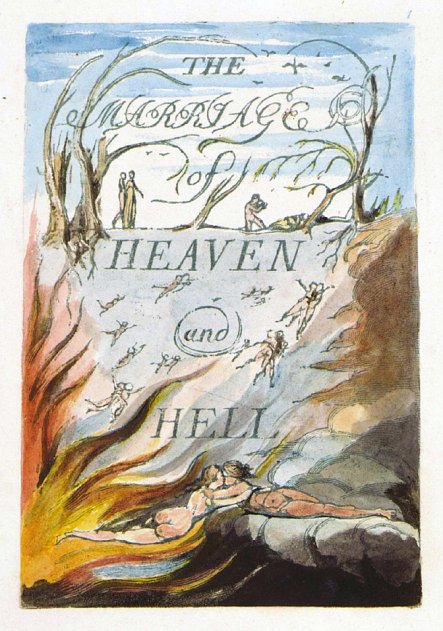
"The Marriage of Heaven and Hell"

Keeping with the theme of Reason vs. Passion, I'd like to now apply it to the ideology of my critic, William Blake, who wrote an entire epic poem addressing this battle.

"The Marriage of Heaven and Hell" tells of an epic descent into hell in the vein of Dante's "Inferno" and Milton's "Paradise Lost". However, Blake's Heaven and Hell in this book are completely reversed from Dante's or Milton's, where Hell is depicted as a burning torture chamber and Heaven a perfect paradise. Blake's Heaven is, effectively, the terrain of the reality principle, and Hell a land where passion reigns. Blake's obvious defense of Hell is testimony to his philosophies as a poet and critic: that all of life should be drawn from imagination, energy, and passion.

Saturday, November 1, 2008

Reason vs. Passion


Our discussions lately in class of Negative Capability brought to mind a poem that meant a lot to me by Kahlil Gibran. It was after reading this poem some years ago that I first acknowledged the existence of that internal struggle between reason and passion that we experience as humans. Before I think I understood it religiously, as a conflict between God's will and Satan's within us, or simpler put, Good vs. Evil. And this poem really opened my eyes to the true struggle, and beautifully depicted I might add. There are almost thirty poems included in this book, "The Prophet", each addressing a different trial of being human, but this was without question my favorite....


Reason and Passion

And the priestess spoke again and said: 'Speak to us of Reason and Passion.'


And he answered saying:

Your soul is oftentimes a battlefield, upon which your reason and your judgment wage war against passion and your appetite.

Would that I could be the peacemaker in your soul, that I might turn the discord and the rivalry of your elements into oneness and melody.

But how shall I, unless you yourselves be also the peacemakers, nay, the lovers of all your elements?

Your reason and your passion are the rudder and the sails of your seafaring soul.

If either your sails or our rudder be broken, you can but toss and drift, or else be held at a standstill in mid-seas.

For reason, ruling alone, is a force confining; and passion, unattended, is a flame that burns to its own destruction.

Therefore let your soul exalt your reason to the height of passion; that it may sing;

And let it direct your passion with reason, that your passion may live through its own daily resurrection, and like the phoenix rise above its own ashes.

I would have you consider your judgment and your appetite even as you would two loved guests in your house.

Surely you would not honour one guest above the other; for he who is more mindful of one loses the love and the faith of both.

Among the hills, when you sit in the cool shade of the white poplars, sharing the peace and serenity of distant fields and meadows - then let your heart say in silence, 'God rests in reason.'

And when the storm comes, and the mighty wind shakes the forest, and thunder and lightning proclaim the majesty of the sky, - then let your heart say in awe, 'God moves in passion.'

And since you are a breath In God's sphere, and a leaf in God's forest, you too should rest in reason and move in passion.

-Kahlil Gibran, "The Prophet"


This is a theme we encounter a lot in literature. As we discussed in class, there is a war between the pleasure principle and the reality principle, what we should do and what we want to do. Depending on what we obide by, we fall into two categories. There are the Don Quijotes, who adhere to the pleasure principle and our desires, who see the world but see something else, too. And then there are the Sancho Panzas, the realists, who adhere to the reality principle.


Wednesday, October 22, 2008

Nabokov: "Quit Laughing at Don Quixote!"


Vladimir nabokov taught a series of lectures on Don Quixote as part of a humanities survey course that he was teaching at Harvard in 1952. The lectures on Don Quixote were meant to serve as an introduction to the rest of the course. This article from the New York Times about Nabokov's obsession with the literary hero explains well his belief that Don Quixote is taken too lightly, that we shouldn't laught so much at his misfortune's (I am VERY guilty of this!) It is not meant to be a heartwarming novel, but rather a heart wrenching one. I will explain this in more depth after i finish the lectures, but this article makes a good introduction!

Mad-man of La Mancha


Last november when i was studying in spain, we made a trip to barcelona which coincided perfectly with an exhibit in the cultural museum there of the spanish artist Salvador Dali's private collection of paintings. There was one room of the exhibit that was completely devoted to Dali's interpretations and art paying homage to the literary hero Don Quijote. The paintings were beautiful, and they mean more to me now after having read don quixote. i wanted to share a few here:


"The road of excess leads to the palace of wisdom"


We cited this quote from William Blake in class today. When I went looking for it online I found a quote of his that I thought summed up the anagogic mindset even better:


“The man who never in his mind and thoughts travel'd to heaven is no artist.” (Blake)


That sounds like exactly what we're getting at with this religious, woo-woo, idea of art and poetry in the anagogic phase. But anyways, back to Blake, he's my critic but I hadn't done any research on him yet, only a list of questions about his criticism that I had intentions of researching and getting the answers to eventually. But, today was the last straw. Every single time we mention Blakes name, it is followed by excess or exhuberance and I can't stand it any more! I need to know what the connection is here between Blake and excess, exhuberance, what does this mean! For starters, dicitonary and thesaurus: exhuberance, because truth be told, i'm not sure i exactly know what that word indicates in it's most literal form, so before applying it to Blake's mentality, dictionary definition:


Of all the synonyms, the one i grasped best was "enthusiasm", which we etymologically traced to mean "in theos" , "in god" as in overtook by the spirit of god, which makes since in this context, the exhuberance of art, the religious aspect of art.


exhuberant: joyously unrestrained or enthusiastic


sounds like rhapsody to me. I imagine the behavior of an exhuberant person as sparking a lot of sideways glances and "woo-woo" critiques. Which leads me to some Blake artwork I found (apparently he was as famous a painter and engraver as he was a poet!)


The abundance of William Blake paintings out there really surprised me, first because i've always heard of William Blake in the context of poetry and had no idea he was a painter/engraver as well and second because these painting are OUT THERE, exhuberant, OVER-THE-TOP, wooo wooooooooo............

((More on Blake to come))

Hymn to Intellectual Beauty


Someone brought this up to class today, and I made a note to myself to look it up (special thanks to bartelby.com- a warehouse of essays and poetry for the romantics!) Here is yet another testimony to the anagogic mindset and the unseen powers that move us... the "IT" Heather was eluding to in her blog:


"It visits with inconstant glance

Each human heart and countenance"


We said in class today that anagogy is "almost a rememberance" A rememberance of what? This is an idea I hope to explore a little more in the coming discussions in class, but regardless it is echoed in this hymn by Shelley..


"I call the phantoms of a thousand hours

Each from his voiceless grave"


And lo and behold! A reference even to the "woo-woo" moment that accompanies these anagogic revalations....


"Of life, at that sweet time when winds are wooing

All vital things ..."


Haha I think i'm just kidding about that one. That's wooing singular, I think it is distinct from "woo-wooing"


As for my favorite line in this gorgeous hymn:


"O awful LOVELINESS,

Wouldst give whate’er these words cannot express."